
Imagine walking through a field of sunflowers, and you notice their seeds. This formation, like much of what we can find in nature, is a masterpiece of engineering. Math is the hidden language of our world; it is found in patterns of the scales of a pinecone, the petal arrangements of a flower, and in the perfect geometry of a honeycomb. When a student realizes that the math they use in class is the same math that organizes so much of what we witness in everyday life, the subject stops being a chore and becomes a moment of discovery and wonder!
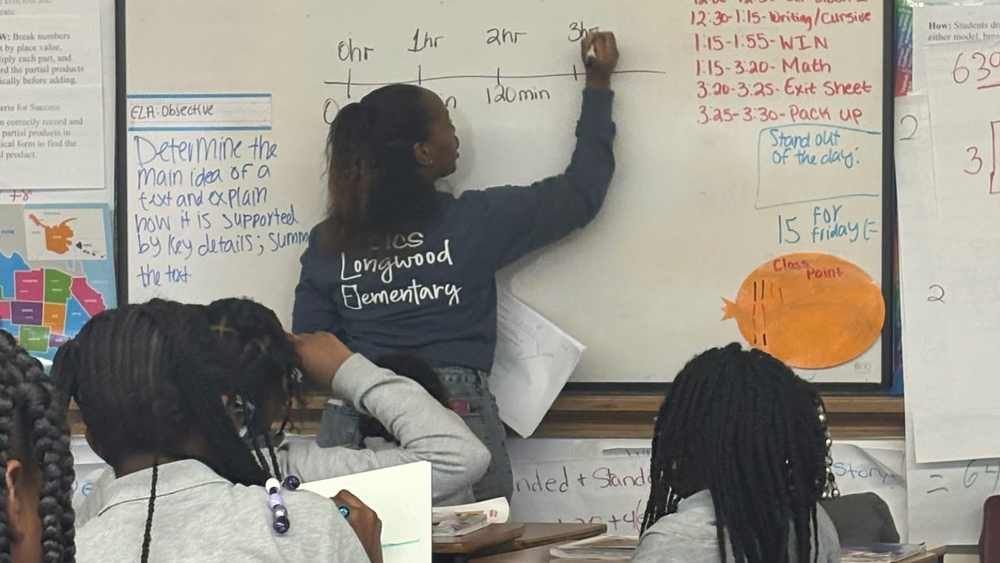
This is a part of why Distinctive Schools is focusing more on STEM (Science, Technology, Engineering, and Math) education. From the perspective of Kelli Easterly, Managing Director of STEM for Distinctive Schools, “we want our students to see themselves not just as learners, but as powerful users of mathematics.” Since joining the team, she and Christy Krier, Distinctive Schools Network Math Specialist have led with students incorporating problem solving into their math practices, not merely solving problems. In practice, this means that instead of rows of students silently completing identical worksheets, you will see students immersed in real-world problem solving. “The goal is to hear learners thinking out loud, sharing the messy or unfinished thoughts in their brain without fear,” shares Christy. Discovering different strategies to reach a solution—together—is an important component to building critical thinking skills because it teaches students that while procedures are helpful, understanding the why conceptually is what grants them true ownership of their education.
“For many adults, math was a source of anxiety—a race to find the one right answer using a memorized formula,” Kelli says. “But we know the stakes are high for our learners. Nationwide, students are often only actively engaged in formal learning for less than 20% of their K–12 day. Through strategic partnerships with families, community based organizations, industry partners, cultural institutions, and enrichment programs, we are determined to capture every bit of that remaining 80%. It will take all of us.” Additionally, about 60% of all jobs require STEM skills, and that number is growing. Perhaps most importantly, math proficiency is the single strongest predictor of a student’s lifelong earning potential.
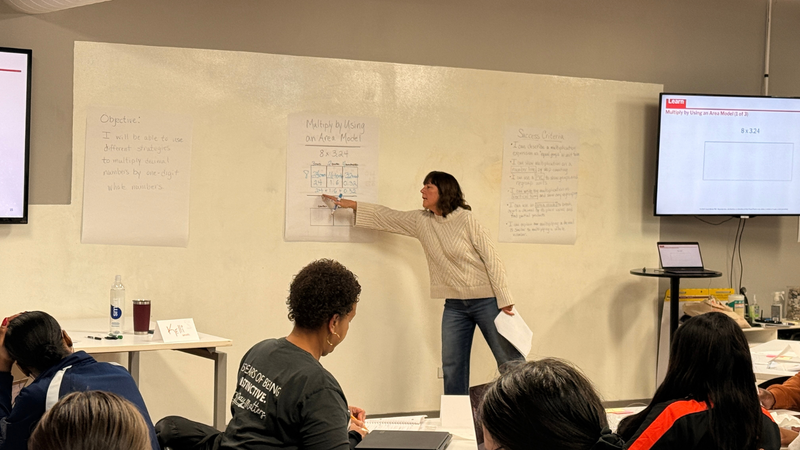
In order to meet this moment, Kelli and Christy are working with school teams, instructional leads, and math teachers to push the boundaries of what’s possible. “We know that as students move through elementary school, the window to close foundational gaps begins to tighten, so we are acting urgently to ensure that every student has the tools they need for a path to economic mobility and academic success,” explains Christy. Through our Math Leads Academy, Distinctive educators are deepening their own conceptual understanding so they can help increase math confidence within their classrooms. “We want every team member to have the access and accountability to use data to inform this practice so that no student is just a number on a spreadsheet,” says Kelli. “There is a brilliant mind waiting to be unlocked behind every data point.”
As Kelli, Christy, and the math teams at Distinctive Schools continue to build math confidence in learners, we are also looking forward to what the future holds. This includes introducing Algebra 1 earlier at schools like CICS Bucktown and CICS Longwood Elementary for next year, developing an academic center for CICS Longwood Elementary, and expanding enrichment opportunities across campuses in STEM, like robotics, science fairs, and makerspaces.
While it’s important to solve for X, we are teaching our scholars to look at a complex world, understand its patterns, and know that they have the tools to shape the future they choose.